
Reading time: approx. 8 minutes
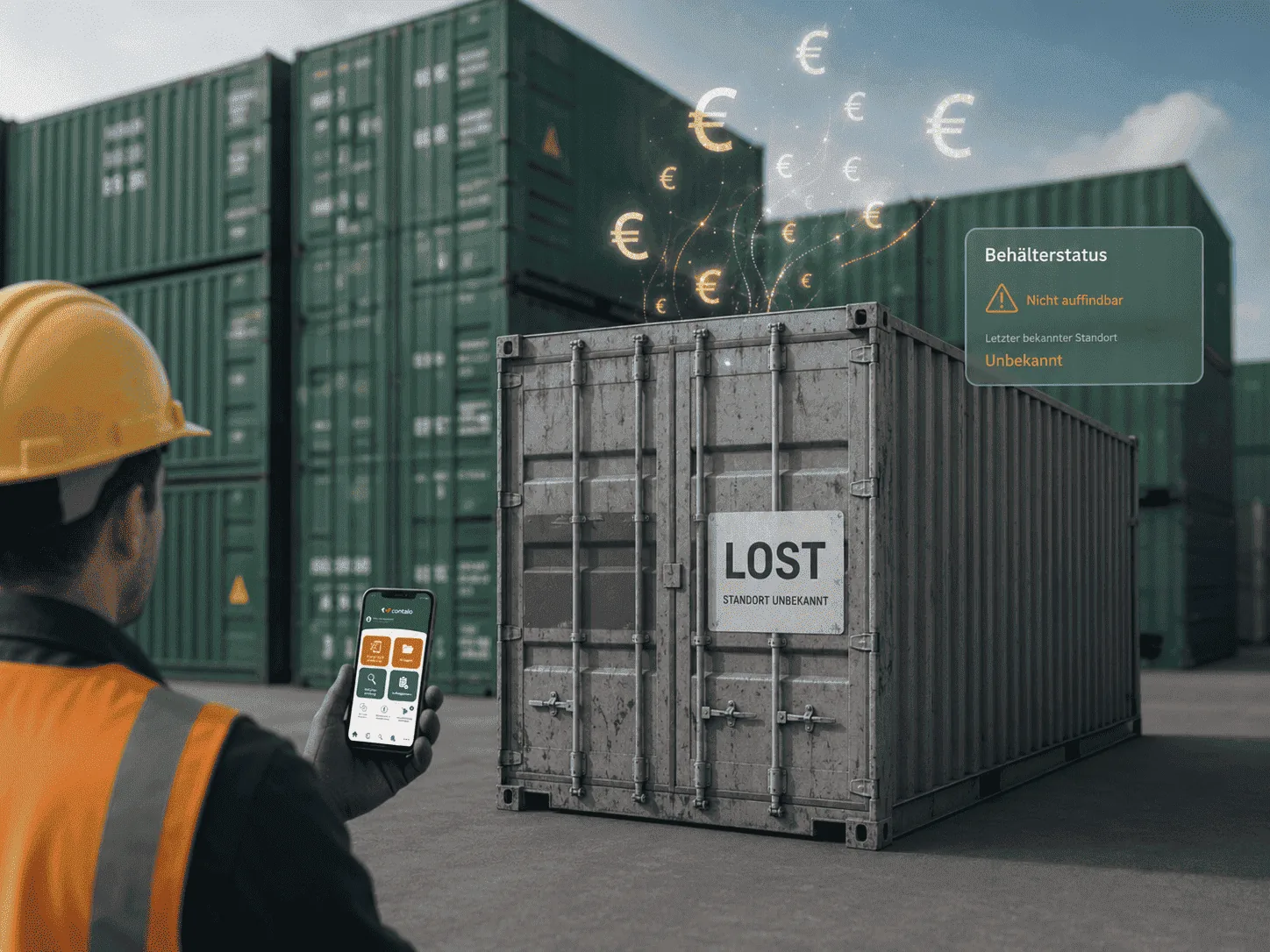
A roll-off truck stands idle because its container is "somewhere on the company premises." A new container is ordered, even though three unused ones are sitting at the neighboring site. The inspection date of a hazardous-materials container is missed — and only comes to light during the operational audit. Scenarios like these play out daily in German waste management companies. The result: quiet but substantial costs — often without anyone noticing how much money is being lost in the process.
This article shows where the biggest cost traps in container management lie, what structured container management concretely delivers — and how the digital container management software contalo brings back visibility.
Containers are invisible capital — and are often underestimated
Containers are operational assets. Mesh pallets, skips, hazardous materials containers, drip trays, waste containers, balers — they all have a purchase price, a location, and a function. But unlike vehicles or machinery, they are rarely recorded systematically. No inventory record, no location entry, no inspection history.
The result is a permanent blind spot: companies reorder knowing what they already have. They search instead of finding. And they only notice missing containers when the customer process or a statutory inspection requirement comes to a halt.
"One site orders new containers even though another site still has sufficient stock — and overdue returns are not not flagged in time." (Presse-Radar, May 2026)
The Four Most Common Cost Traps in Container Management
1. Unnecessary Purchases Due to Lack of Inventory Visibility
Anyone who has no overview of their container stock buys too much — or at the wrong time. Especially in organizations with multiple sites or sprawling outdoor premises, central inventory data is missing. As long as no system clearly shows which container is available where, dispatchers rely on gut feeling and order as a precaution.
2. Inefficient Rental Processes Without Location Transparency
Rented containers or those provided by the waste disposal company incur costs every day. If they remain at a site longer than necessary because no one coordinates the pickup, avoidable rental fees accumulate. Without digital transparency on location and dwell time, these costs can hardly be controlled or passed on to the customer. There is also no visibility into the number of jobs per container — an important basis for process optimization.
3. Personnel Effort for Manual Searching and Administration
Wherever containers are still managed with a clipboard, Excel, or paper logs, significant administrative effort arises. The responsible staff must inspect and maintain equipment, conduct audits, manage services, and ensure regulatory compliance — a scope of tasks that grows massively due to a lack of structure. These personnel costs are real costs, even if they never appear on any container invoice.
4. Missed Inspection Obligations and Fines
Many containers are subject to statutory inspection obligations under the German Industrial Safety Regulation (BetrSichV) or the accident prevention regulations (UVV/DGUV). Without an overview of the container inventory, inspection dates are easily missed. The consequences are significant: violations can result in fines of up to €25,000 and, in serious cases, criminal proceedings or the loss of insurance coverage.
Numbers That Speak for Themselves
| 5–15 % of logistics costs are attributable to waste disposal logistics | 25.000 € max. fine for missed inspection obligations | < 10 % Degree of digitalization in the waste management sector (laggard) |
The Silent Cost Driver: Systemic Lack of Transparency
The actual problem is not the single lost container. It is the systemic lack of transparency that creeps in and entrenches itself. Where processes are manual, gaps arise. And where gaps arise, costs arise.
Typical symptoms of poor container visibility in waste management companies:
- Containers are "missing" and replacements are ordered — even though the original container is still on the premises
- UVV inspection dates are tracked manually in a calendar and forgotten
- During site relocations, containers are permanently lost because no location history exists
- Disposal companies are commissioned for collections that are not yet necessary — due to a lack of real-time visibility
- Different departments reorder the same container type without knowing about each other
| Note for Companies with Multiple Sites With each additional site, the transparency risks multiply. Without a central container management system, parallel workarounds emerge — Excel here, WhatsApp there, a clipboard at the site office — which together do not add up to a coherent picture. |
What Structured Container Administration Concretely Delivers
Companies that systematically record and track their container inventory report the same results: fewer reorders, less time spent searching, fewer missed inspection dates. This is not theory — it is the logical consequence of transparency.
A well-known industry example illustrates the financial impact: a Dresden-based aerospace supplier paid around €10,000 per year for the disposal of packaging material alone. Through structured recording and active resource management, this cost factor turned into a gain of €40,000 within one year. The decisive first step: simply knowing what is available and where. (Source: Beschaffung Aktuell)
The three building blocks of effective container management:
- Unique identification: Each container receives a unique ID — e.g., via QR code — making it traceable and assignable at any time.
- Location history: Where did the container come from, where is it now, where does it go next? Complete location tracking prevents losses and enables better dispatching.
- Inspection and deadline management: Statutory inspection obligations (UVV, BetrSichV, DGUV) must be automatically flagged and verifiably documented — not in a calendar, but in the system.
How contalo Restores Visibility
contalo (www.contalo.de) is a digital container management platform developed for precisely this purpose: structured, legally compliant container management for waste management companies and industrial operations that need transparency over container inventory, locations, and inspection obligations — without unnecessary complexity.
What contalo concretely addresses:
- Unique recording and administration of all containers via QR code scan
- Clear location overview and complete location history
- Guided, structured UVV inspections directly on site — with offline capability (Android app)
- Complete documentation of all relevant activities for audits and operational inspections
- Web application for administrative roles, Android app for operational staff
- Integration of your own tracking sensors for automated location recording
The result is not a digitalization project for its own sake — but a concrete financial lever: fewer new purchases, fewer fines, less time spent searching. More control through transparency and structure.
Frequently Asked Questions (FAQ)
What is container management software?
Container management software is a digital platform for the administration, location tracking, and inspection planning of bins, containers, and load carriers within an organization. It replaces Excel lists and paper logs with a centralized, audit-proof solution. contalo is one such platform, developed specifically for waste management companies.
What are UVV inspections and who is required to carry them out?
UVV inspections (accident prevention regulations) are legally mandated safety inspections for work equipment and operational facilities — including skip containers, roll-off containers, balers, and hazardous materials containers. They are governed by the DGUV regulations and the German Industrial Safety Regulation (BetrSichV). Missed inspections can result in fines of up to €25,000.
How significant is the savings potential through digital container management?
The savings potential depends on company size and the current level of digitalization. Unnecessary purchases, avoidable rental costs, personnel effort for manual administration, and potential fines can quickly add up to five-figure annual amounts in mid-sized waste management operations. Practical examples from industry show that structured recording can turn five-figure cost factors into savings — or even revenue.
Does the contalo app also work without an internet connection?
Yes. The contalo Android app works offline. UVV inspections and container recordings can be completed without a mobile connection and synchronized afterward — ideal for use on company premises, in warehouses, or in areas with poor network coverage.
Conclusion: Container Losses Are Not Fate — They Are a Symptom of Missing Structure
Companies that do not know their containers pay twice: once when buying and once when searching. Those who, by contrast, bring stock, location, and inspection obligation together in a central container management system gain not only an overview but hard cash. Getting started is easier than expected — contalo makes it possible.
Schedule a meeting www.contalo.de/kontakt/
See all features: www.contalo.de/features/
Sources and References
[1] Presse-Radar, „Lademittelprozesse digital steuern: Verluste vermeiden, Planung verbessern, Kosten reduzieren” (Mai 2026) – https://www.presse-radar.de/2026/05/11/lademittelprozesse-digital-steuern-verluste-vermeiden-planung-verbessern-kosten-reduzieren/
[2] Resourcify, „Die Kosten des Abfallmanagements im Fokus” (2024) – https://www.resourcify.com/de/ratgeber/die-kosten-des-abfallmanagements-im-fokus-wie-hoch-sind-die-kosten-von-abfall
[3] Partbase, „UVV-Prüfung 2025: Pflichten, Fristen & Checklisten” (2025) – https://www.partbase.com/de/blog/uvv
[4] Business Wissen, „Entsorgung in Unternehmen: Welche Kosten & Erträge entstehen?” – https://www.business-wissen.de/hb/entsorgung-in-unternehmen-welche-kosten-ertraege-entstehen/
[5] Beschaffung Aktuell / Industrie.de, „Margen beim Müll” – https://beschaffung-aktuell.industrie.de/allgemein/margen-beim-muell/
[6] adesso Blog, „Die Digitalisierung in der Abfallwirtschaft” (2023) – https://www.adesso.de/de/news/blog/die-digitalisierung-in-der-abfallwirtschaft-herausforderungen-und-chancen.jsp


