
Reading time: approx. 7 minutes
At the end of May 2026, the Federal Cabinet delivered a significant political announcement: a 565-million-euro action program for the circular economy was adopted — financed from the Climate and Transformation Fund as well as the climate protection programs for 2026 to 2030. The program defines twelve priority fields, from public procurement to the recycling of critical raw materials, and includes its own digitalization initiative with concrete tools for practical use.
For waste management companies, logistics operations, and industry, this is not an abstract political signal. It is a clear call to action: those who digitalize their container management now are prepared for the upcoming regulatory requirements. Those who wait will come under time pressure.
What's in the Action Program for the Circular Economy?
With the action program for implementing the National Circular Economy Strategy (NKWS), the Federal Cabinet has adopted three central levers:
- Investment funding: The new "Future Circular Economy" funding program aims to establish companies in Germany as global market leaders in circular technologies. By 2030, the recycling rate for critical raw materials is to rise to 25 percent.
- Digitalization initiative: The centerpiece of the program. This includes the Circular Economy Information System (CEIS) for the digital recording of material flows, as well as funding programs such as "DigiRess Circular" and the "Green AI Hub" for SMEs.
- Circular public procurement: Through a reform of Section 45 of the Circular Economy Act, sustainability and circularity criteria are to become more binding in public contract awarding.
The German Association for Waste, Water and Circular Economy (BDE) endorses the direction: "The action program brings momentum to the implementation of the National Circular Economy Strategy. It relies on digitalization, resource efficiency, and innovation — that is the right path." (Anja Siegesmund, BDE)
The Digital Product Passport Is Coming from 2027 — What Does That Mean in Practice?
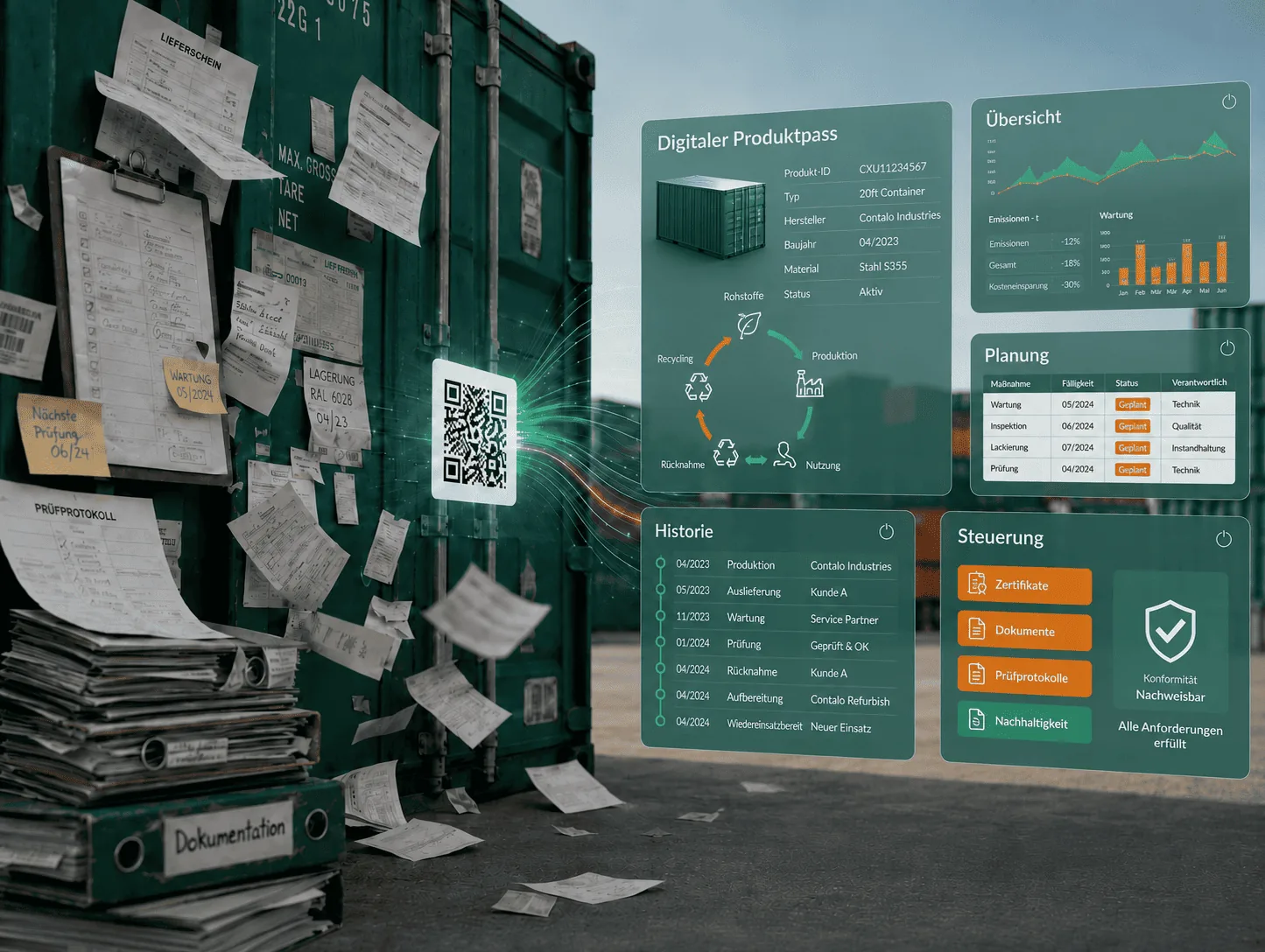
| Briefly explained: What is the Digital Product Passport (DPP)? Der Digitale Produktpass ist ein zentrales Instrument der EU-Ökodesign-Verordnung (ESPR, in Kraft seit Juli 2024). Er funktioniert wie ein digitaler Zwilling für physische Produkte: Materialzusammensetzung, CO₂-Emissionen, Reparierbarkheit und Recyclingfähigkeit müssen über den gesamten Lebenszyklus nachvollziehbar dokumentiert sein. Zeitplan der Einführungspflicht: • Ab 2027: Industrie- und Fahrzeugbatterien, Stahl, Eisen, Aluminium • 2027–2030: Schrittweise Erweiterung auf Elektronik, Textilien, Möbel, Bauprodukte und Maschinen |
For companies that use containers for hazardous substances, special waste, or industrial materials, the consequence is clear: complete digital recording digital recording of the origin, condition, and whereabouts of these containers is shifting from good practice to a regulatory requirement. Those who do not set up their container management digitally today will not be able to meet the requirements of the Digital Product Passport.
The Federal Government states it clearly: "Physical material flows must be linked with digital data flows. On this basis, the life paths of materials and products can be traced across the value-creation stages." (Kreislaufwirtschaft-Deutschland.de)
The Blind Spot in Many Operations
The political course has been set. But operational reality lags far behind: many companies still manage their container stock with Excel lists, paper records, or not at all. According to the digitalization index of the Federal Ministry for Economic Affairs and Climate Action, the waste management sector remains one of the least digitalized economic sectors in Germany.
Yet it is precisely this sector that is most directly affected by the political requirements. The circular economy only works if the data is correct — and data is only correct if it is recorded in a structured way. Anyone who does not know which container holds which material, where it is located, and what its inspection status is will not be able to meet the requirements of the coming regulatory wave.
Three Fields of Action: What Companies Should Tackle Now
1. Record the Container Inventory Completely and Unambiguously
Every container — whether a hazardous materials container, waste container, or load carrier — needs a unique ID, a documented location, and an inspection history. Without this foundation, neither a circular economy nor regulatory compliance is possible. Container management software like contalo creates the necessary transparency.
2. Manage Inspection Obligations Digitally
UVV inspections, DGUV deadlines, and official inspection obligations must be verifiably documented. Paper logs are not a reliable basis in operational audits or in the event of a claim. Digital UVV inspections create legal certainty — and automatically provide reminders of upcoming deadlines.
3. Build a Data Foundation for Sustainability Reporting
CSRD, CO₂ accounting, and, in the future, the Digital Product Passport require that companies know and can demonstrate their material flows. Those who begin today to record container and location data in a structured way are building exactly the data foundation that will be needed tomorrow for sustainability reports and supply chain compliance obligations.
How contalo Prepares Your Company for the New Requirements
contalo (www.contalo.de) is a digital container management platform that closes precisely the operational gap that the Federal Government's action program addresses at the policy level: the missing digital transparency about container stock, container location, and inspection obligations in waste management companies and industrial operations.
The platform combines operational execution and administrative control in a single system:
- Container recording via QR code scan — unique identification, even offline
- Complete location overview and history of all containers in stock
- Structured, guided UVV inspections directly on site — via Android app, even without a mobile connection
- Complete documentation of all processes — audit-proof and retrievable at any time
- Connection of tracking sensors for automated location data
- Web application for administrative roles, Android app for the operational team
For companies with specific requirements — ERP integration, industry-specific inspection processes, or a white-label solution in their own corporate design — SMF, the company behind contalo, also offers custom software development.
Frequently Asked Questions (FAQ)
What Is the Federal Government's Circular Economy Action Program?
The action program for the National Circular Economy Strategy (NKWS) was adopted by the Federal Cabinet at the end of May 2026. It comprises 565 million euros and defines twelve priority fields, including a digitalization initiative with the Circular Economy Information System (CEIS) and programs to promote the Digital Product Passport. The goal is to position Germany as a leading location for circular technologies.
From When Does the Digital Product Passport (DPP) Apply?
From 2027, the Digital Product Passport will become mandatory in stages — initially for batteries as well as steel, iron, and aluminum. By 2030, electronics, textiles, furniture, construction products, and machinery will follow. It is based on the EU Ecodesign Regulation (ESPR), which came into force in July 2024.
Why Do Waste Management Companies Need Container Management Software?
Waste management companies are increasingly dependent on complete container data due to the Digital Product Passport, CSRD reporting obligations, and UVV inspection requirements (BetrSichV, DGUV). Container management software like contalo records container inventory, locations, and inspection history digitally — creating the foundation for regulatory compliance and operational efficiency.
What Does a Lack of Digitalization in Container Management Cost?
A lack of digitalization leads to unnecessary new purchases, increased rental costs due to uncoordinated pickups, personnel effort for manual searching, and — in the worst case — fines of up to €25,000 for missed UVV inspection obligations.
Conclusion: The Political Signal Is Clear — Implementation Is Up to You
The Federal Government's 565-million-euro action program is more than a funding program. It is a structural change of direction: digital transparency about material flows and container stock is shifting from an optional improvement to an increasingly regulation-enforced foundation of doing business. For operations in waste management, industry, and logistics, the same applies: now is the right time to digitalize your processes with container management software — not because the legislator demands it, but because it makes economic sense and the requirements are coming regardless.
contalo helps you take this step in a structured way and without unnecessary effort.
Schedule a meeting www.contalo.de/kontakt/
See all features: www.contalo.de/features/
Sources and References
[1] Ad-hoc-News, „Kreislaufwirtschaft: Kabinett beschließt 565-Millionen-Programm“ (Mai 2026) – https://www.ad-hoc-news.de/wirtschaft/kreislaufwirtschaft-kabinett-beschliesst-565-millionen-programm/69451240
[2] BDE Bundesverband der Deutschen Entsorgungs-, Wasser- und Kreislaufwirtschaft, „Aktionsprogramm Kreislaufwirtschaft“ (Oktober 2025) – https://www.bde.de/presse/aktionsprogramm-kreislaufwirtschaft/
[3] Kreislaufwirtschaft-Deutschland.de (NKWS), „Digitalisierung und Circular Economy“ – https://www.kreislaufwirtschaft-deutschland.de/kreislaufwirtschaftsstrategie/handlungsfelder/digitalisierung-und-circular-economy
[4] DFGE Institute, „Der Digitale Produktpass: Zeitplan, Produktgruppen und Bedeutung für Unternehmen“ (Mai 2026) – https://dfge.de/der-digitale-produktpass-zeitplan-produktgruppen-und-bedeutung-fuer-unternehmen/
[5] adesso Blog, „Die Digitalisierung in der Abfallwirtschaft“ (2023) – https://www.adesso.de/de/news/blog/die-digitalisierung-in-der-abfallwirtschaft-herausforderungen-und-chancen.jsp
[6] IHK Südlicher Oberrhein, „Bundeskabinett beschließt Klimaschutzprogramm 2026“ – https://www.ihk.de/freiburg/unternehmen-beraten/umwelt-energie-und-klimaschutz/nachhaltigkeit-und-klimaschutz/klimaschutzprogramm-2026-7011654


